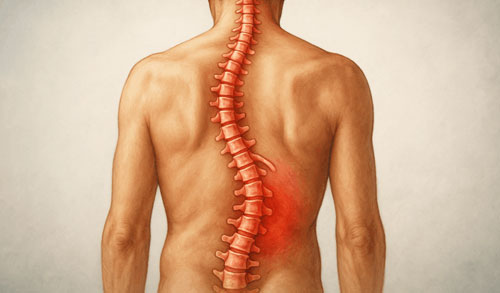
Scoliosis
Scoliosis is a condition where the spine curves sideways instead of maintaining a straight alignment. It can occur in children, teenagers, or adults and may range from mild to severe.
In many cases, mild scoliosis may not cause significant symptoms, but more pronounced curves can affect posture, balance, and overall spinal health if left untreated.
Common Causes
Scoliosis may occur due to:
- Idiopathic (unknown cause, most common)
- Congenital spine abnormalities (present from birth)
- Neuromuscular conditions affecting muscles and nerves
- Degenerative changes in adults
- Spinal injuries or infections
Symptoms
You may notice:
- Uneven shoulders or hips
- Visible sideways curvature of the spine
- Back pain (more common in adults)
- Leaning to one side
- Difficulty maintaining proper posture
Treatment Approach
Treatment depends on the age, severity, and progression of the curve. Options may include:
- Regular monitoring for mild cases
- Physiotherapy and posture correction exercises
- Bracing to prevent progression (especially in growing children)
- Pain management for symptomatic cases
In severe or progressive cases, surgical correction may be required to straighten and stabilize the spine.
Benefits of Early Treatment
Early detection and care can help:
- Prevent progression of spinal curvature
- Maintain proper posture and balance
- Reduce risk of complications
- Improve long-term spinal health
Simple Prevention Tips
While some forms cannot be prevented, you can:
- Ensure regular spine check-ups in growing children
- Maintain good posture habits
- Stay physically active
- Strengthen back and core muscles
- Seek early medical advice if posture changes are noticed
The goal of treatment is to control curvature, improve posture, and maintain a healthy and balanced spine.
FAQs
It is a sideways curvature of the spine that affects posture and alignment.
Yes, it commonly develops during growth spurts in children and teenagers.
Yes, mild to moderate cases can often be managed with physiotherapy and bracing.
Surgery is recommended in severe or rapidly progressing curves affecting function or appearance.